 Nairobi National Park Tours
Home › Guides › Visiting Nairobi National Park: Getting There, Timing and Tips
Visiting Nairobi National Park: Getting There, Timing and Tips
The best time to visit Nairobi National Park is the dry months from July to October, with a dawn entry between 6:00 and 9:00 AM when predators are most active. The park sits 7 to 10 km from downtown Nairobi, so a half-day visit of 4 to 5 hours is enough for a proper safari.
Quick answer The short answer on timing, cost and access
July to October is the best window, when short grass and sunny weather make wildlife easier to spot. The gates open at 6:00 AM and predators are most active between 6 and 9 AM. Entry costs $80 (KES 10,400 approx) per adult non-resident per KWS's fee schedule, and the park is 7 to 10 km from the city centre, about 15 minutes by road.
Key takeaways
- Compare every nairobi national park tour by price, vehicle and fees
- Check things to do in Nairobi National Park beyond the game drive
- See Giraffe Centre Nairobi: Fees, Hours and Feeding for the classic add-on
- Short on time? The 6-hour airport layover drive fits between flights
What is the best time to visit Nairobi National Park?
The dry months from July to October is the best time, with January and February rated excellent too.
Kenya Wildlife Service groups July to December and December to March as the high season for game viewing, citing short grass and sunny weather that make wildlife easier to spot. April to June is the low season because of the long rains. The table below lines up the month ratings for the park.
Month by month
Wildlife viewing is best in the dry months from July to October, but the park can be visited year-round. In the dry months the grass is short and animals gather at water sources, which concentrates the sightings. The trade-off is dust and less pleasing scenery.
There is also a dry spell between the rains in January and February that makes those months a great time to visit. If you want the migration as well, wildebeest and zebra herds move through the park between July and August as part of a migration running July to October.
| Months | Rating | What to expect |
|---|---|---|
| January and February | Excellent | Dry spell between the rains, short grass |
| March | Fair | Rains building |
| April and May | Poor | Long rains, muddy tracks, scattered animals |
| July to October | Excellent | Short grass, animals at water, wildebeest and zebra July to August |
| November | Fair | Short rains, newborn animals and migratory birds |
| December | Good | Sunny weather returns |
Dry season or wet season
In the wet season there are newborn animals, migratory birds and green scenery, but animals scatter, the grass is long and some tracks get extremely muddy. If you travel between April and June, a 4x4 is the safer pick over a van, which is why the 5-Hour 4x4 Safari with Pickup earns its place on a wet-month shortlist.
One crowd warning: the park can be very crowded over the Easter long weekend. If a quiet drive matters to you, avoid that weekend and go at opening time instead.
What is the best time of day for game viewing?
Enter at the 6:00 AM gate opening, because predators are most active between 6 and 9 AM.
Time of day matters as much as month. The gates open at 6:00 AM and close at 6:00 PM, and animals are most active before the heat of the day.
The early window
Early morning timing of 6:00 AM to 12:00 PM is best to catch predators, which are most active between 6 and 9 AM. This is why the shared drives collect guests at their hotels before dawn. The ride to the gate takes about 30 minutes from central Nairobi, and you then spend about 4 to 5 hours on the park tracks before returning around lunchtime.
The early start also unlocks the combination days. The Sheldrick nursery's public visit runs exactly 11:00 AM to 12:00 noon daily, so a dawn game drive still leaves time to reach the Mbagathi Gate for the 11 AM elephant feed.
Afternoon and evening
Afternoon options suit late arrivals and layovers. The Evening Game Drive and Sundowner picks up between 1:00 and 2:00 PM and stops for a sundowner near Hyena Dam before the 6:00 PM closing. After dark the park is closed to standard drives, so a night visit only works as an escorted product with a KWS ranger.
Source: Kenya Wildlife Service.
Tours That Fit
These tours match the dawn-entry plan and the dry-season calendar.
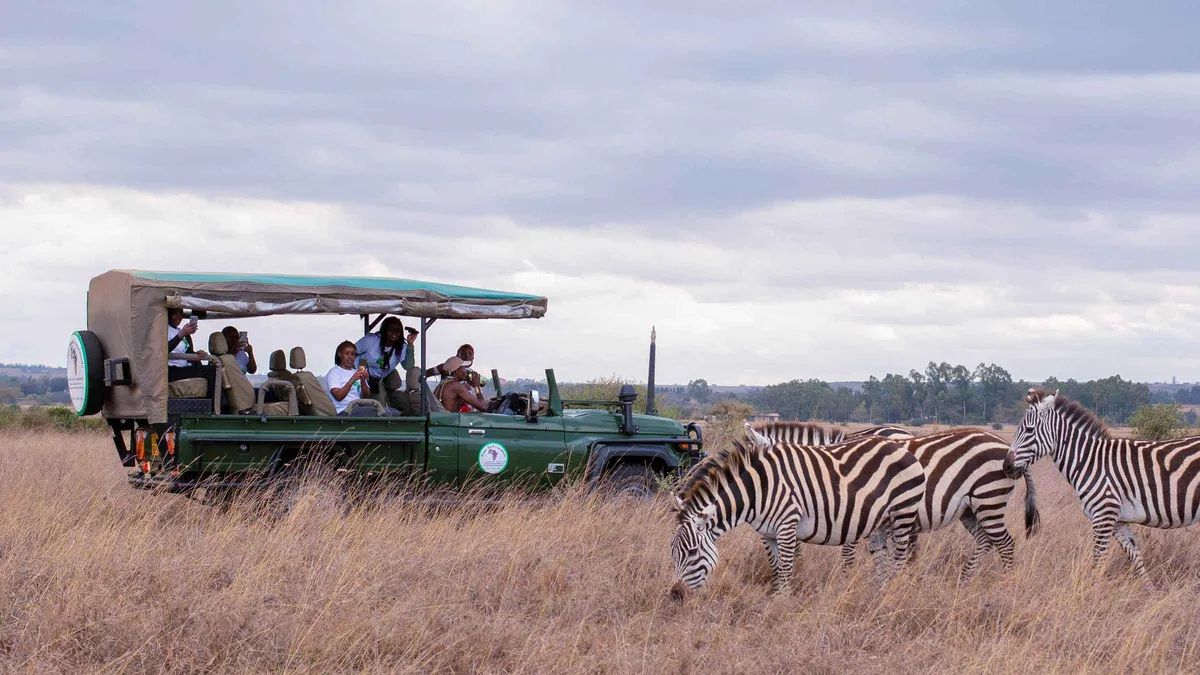
Nairobi National Park Half-Day Game Drive
Four hours on the plains in an open-roof van, morning or afternoon, with hotel pickup. The $80 KWS fee is bought online on top.
- Cancellation
- Free cancellation 24h
- Operator
- Kenya Bush Expeditions
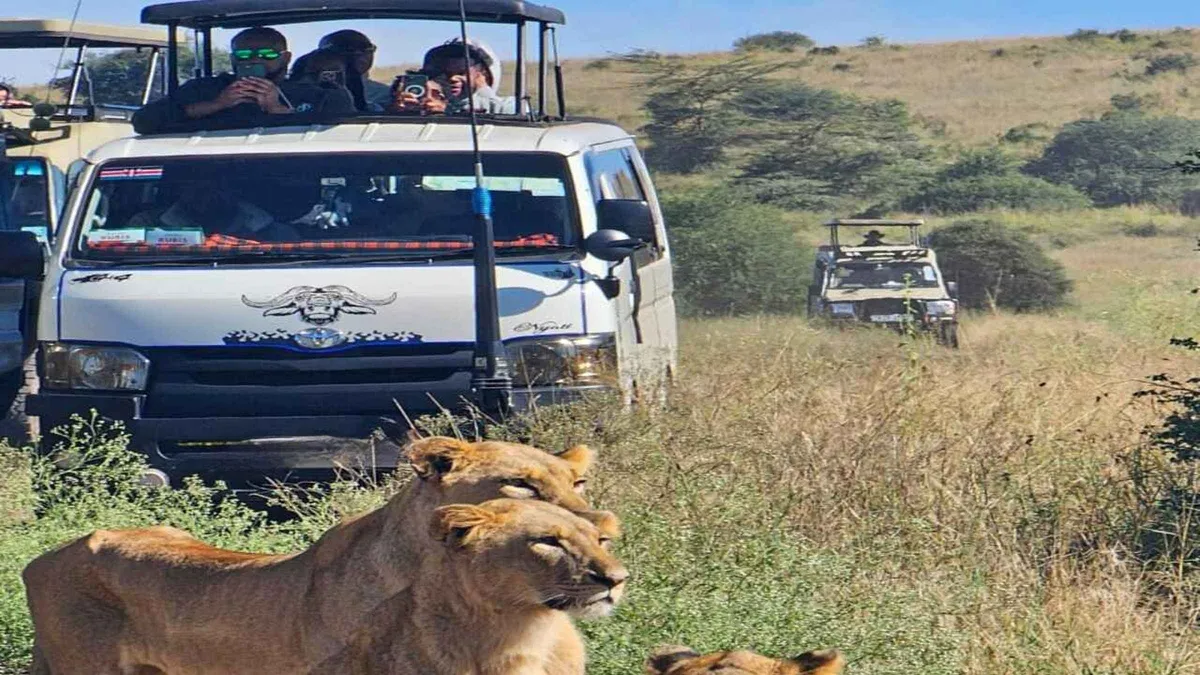
Nairobi National Park 5-Hour Guided Game Drive with Pickup
A five-hour drive with Wi-Fi in the vehicle and guides in English, German, French and Spanish. Pickup time confirmed the day before.
- Cancellation
- Free cancellation 24h
- Operator
- Giovanni Safaris
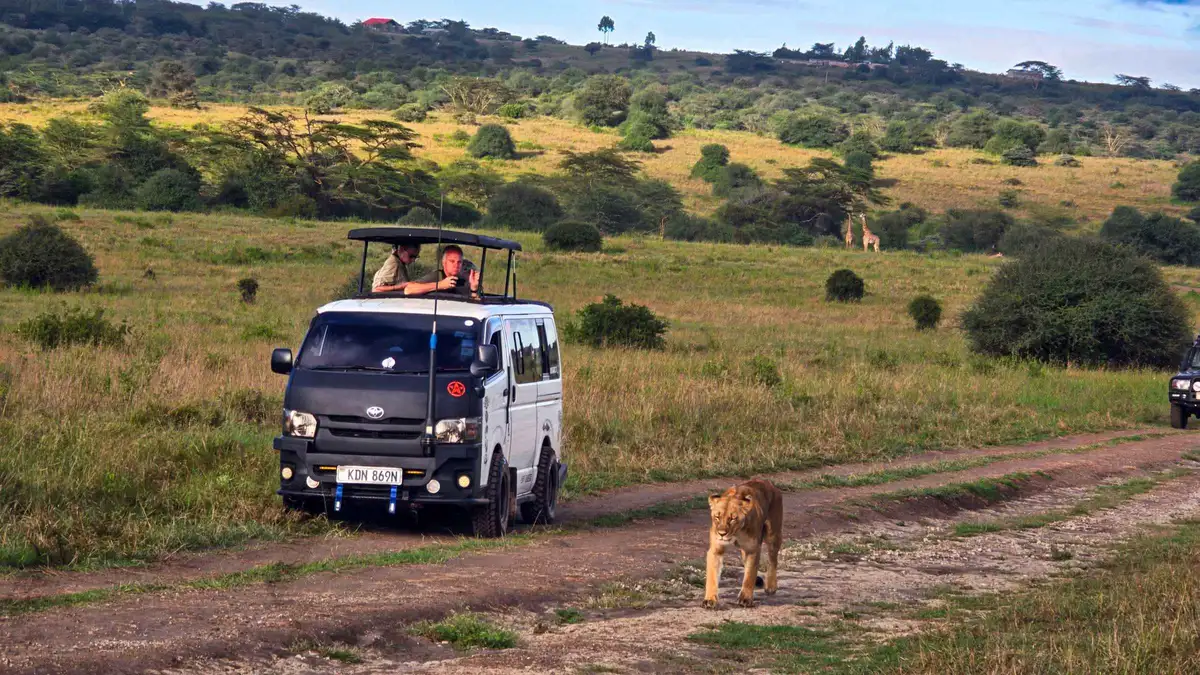
Nairobi National Park 5-Hour 4x4 Safari with Pickup
The same five hours in an open-roof 4x4 rather than a van, with a stop at the Ivory Burning Site. Morning, afternoon or evening.
- Cancellation
- Free cancellation 24h
- Operator
- Eloquent Tours
Where is Nairobi National Park located and how do you get there?
The park lies 7 to 10 km south of central Nairobi, about a 15 minute trip from downtown, reached via Langata Road.
It is known as the most urban national park in the world, and the ride from the centre takes about 15 minutes.
Distance and gates
KWS's own text gives two figures for the same park: its About section says 10 km from the Central Business District, while its How to get there section says about 8 km from the CBD via Nyayo National Stadium and Langata Road, just past Langata Army Barracks. Other sources put it at 7 km from downtown. Whichever figure you use, budget about 15 minutes from the centre and 30 minutes from most hotels to the gate.
The main entrance area sits on Lang'ata Road beside the KWS headquarters, and the East Gate sits on Nairobi Park East Gate Road in the South C area of Langata. If you use a ride-hailing app, check the pin leads to Nairobi Safari Walk or KWS headquarters rather than deep into the park, which vehicles cannot reach.
| Starting point | Time to the gate |
|---|---|
| Downtown Nairobi | About 15 minutes |
| Central Nairobi hotels | About 30 minutes |
| Jomo Kenyatta International Airport | Six-hour layover tours run from arrivals |
With your own car or a tour
The park is close to the city, easy to get to and easy to navigate, with open plains and levelled roads, and visitors recommend getting a map. You can drive your own vehicle through the park on the day. If you would rather have a driver and guide, the shared Half-Day Game Drive is the cheapest entry at $33 per person, and private vehicles start from $90 per person.
Source: Kenya Wildlife Service.
How much are Nairobi National Park tickets and how do you pay?
Entry is $80 per adult non-resident and $40 per child non-resident, paid online or at the gate by card or M-Pesa.
Kenya Wildlife Service publishes a conservation fee schedule, and the figures below come from it. Most tour prices leave this fee outside the sticker price, so add it before you compare.
The fee table
The KWS conservation fee schedule confirms Nairobi National Park entry at the rates below. A Nairobi Package combining the park, the Animal Orphanage and the Safari Walk costs $105 per adult non-resident and $55 per child non-resident if you want all three.
| Visitor category | Adult | Child |
|---|---|---|
| Non-resident | $80 | $40 |
| African citizen | $40 | $20 |
| Kenya resident | KES 1,350 | KES 675 |
| East Africa citizen | KES 1,000 | KES 500 |
Paying and what tours include
Shared half-day drives from $33 per person all leave the $80 adult park fee outside the listed price, and the guide helps you buy the ticket at the gate by card or M-Pesa. The fee-included listings put it inside: the Private Land Cruiser Day Tour with park fee included at $257 and the Half Day Private Tour with all fees included at $194.81. With those two, the price you see is close to the price you pay.
If you are adding the Sheldrick elephant orphanage, its nursery visit costs $20 per adult plus the standard park fee, and the Giraffe Centre entry is $15 per person on the day, each source named in the notes below.
Source: Kenya Wildlife Service.
Can you do Nairobi National Park as a day trip?
Yes, a half-day of 4 to 5 hours inside the park is enough, and a full day adds the elephant orphanage and the Giraffe Centre.
Because the park sits 15 minutes from downtown, it works as a morning, an afternoon or a full day from the city.
The half-day plan
Enter at 6:00 AM, drive the tracks for 4 to 5 hours and be back at your hotel around lunchtime. That covers the predator window and the main circuit, including the Ivory Burning Site where twelve tons of confiscated ivory were burned in 1989. The Half Day Game Drive and the 5-Hour Guided Game Drive both run this format with hotel pickup.
The full-day plan
A full day pairs an early game drive, the Sheldrick Wildlife Trust Elephant Orphanage between 11 AM and 12 PM, then the Giraffe Centre. The sequence works because the gates open at 6:00 AM and the nursery window is fixed. The Nairobi National Park, Elephant Orphanage and Giraffe Centre Shared Day runs exactly this order for $35 per person, collecting guests between 5:20 and 6:00 AM.
Source: Kenya Wildlife Service.
Is a Nairobi National Park safari worth it?
Yes, for rhino sightings and a family-friendly safari minutes from the city, it is widely considered worth it.
The park holds one of Kenya's densest black rhino populations and supplies rhinos to other parks, so a rhino sighting is a realistic goal on a half-day drive.
What you can see
The park has four of the Big Five, with no elephants inside the reserve itself. It covers 117 sq km (45 sq mi), about 30,000 acres, and was opened in 1946 as Kenya's oldest national park. More than 400 bird species live here. Leopards are the hardest cat to find, though researchers have studied the urban leopard in the park since 2009, collaring four between 2009 and 2011, and two famous residents are Koko the female and a large male named Nguruman.
Travellers describe the park as absolutely worth visiting, especially as the first stop on a Kenya itinerary, and note the high chance of seeing rhino. If the Great Migration is your main goal, the wildebeest and zebra herds cross the park between July and August, part of a migration running July to October.
What should you bring to Nairobi National Park?
KWS's visitor tips list clean drinking water, a camera, binoculars, sunscreen, insect repellent and sunglasses.
Pack for an open vehicle and a big temperature swing between dawn and midday.
The packing list
The official tips cover the essentials, and a light layer for the early morning helps on top of them. If you are visiting in the wet season, closed shoes matter because some tracks get extremely muddy.
The nearby extras
At the main entrance, the Nairobi Safari Walk's raised wooden boardwalk gives views of animals, River Mokoyet and the park's rocky thickets, and the Nairobi Animal Orphanage inside the park rehabilitates orphaned, injured and abandoned wildlife. Both make easy additions to the same trip.
Sources: Kenya Wildlife Service, Kenya Wildlife Service.
Is Nairobi National Park good for kids and less mobile visitors?
Yes, the park welcomes families, couples and organized groups, and game drives need no walking.
KWS states the park welcomes families, couples and organized groups for game drives and outdoor experiences.
Families and wheelchairs
A game drive happens entirely from the vehicle, so it suits children and visitors with limited mobility better than a walking safari. The Nairobi Safari Walk next to the main gate adds a raised wooden boardwalk with level access to animal views. The shared drives cap groups at 15 to 20 people, and a private vehicle gives a family its own pace and a window seat each.
Specific step-free facilities at the gates are not stated, so contact KWS on its hotline 0758854363 or WhatsApp +254 726 610509 before you go.
Source: Kenya Wildlife Service.
What are the rules for visiting Nairobi National Park?
The gates open at 6:00 AM and close at 6:00 PM, the Sheldrick nursery must be booked through the Trust itself, and stay in your vehicle on the tracks.
A few fixed rules shape any visit, and the fixed nursery window is the one that most often catches travellers out.
Hours and bookings
The gates open at 6:00 AM and close at 6:00 PM unless you are staying overnight inside the park, which is what makes an escorted after-dark drive the exception rather than a standard visit. The Sheldrick orphanage is open to the public for one hour every day, 11:00 AM to 12:00 noon, and the Trust books visitors only through its own office by email in advance, saying it does not accept bookings made through Viator, GetYourGuide or Tripadvisor. So before paying for a combo tour, ask the operator exactly how it secures the Trust booking for your date.
In the park
KWS publishes no detailed public rules list for this page beyond its visitor tips, so follow your driver's and the gate staff's instructions on the day. Keep to the marked tracks, which are levelled and easy to navigate with a map.
Source: Kenya Wildlife Service.
FAQ
When should you avoid visiting Nairobi National Park?
April and May are rated poor because of the long rains, with scattered animals and muddy tracks, and the Easter long weekend can be very crowded.
What is the best month for wildlife in the park?
July to October is rated excellent, with short grass and animals gathered at water, and the wildebeest and zebra herds pass through in July and August.
What time does Nairobi National Park open?
The gates open at 6:00 AM and close at 6:00 PM, and the best wildlife window is 6:00 to 9:00 AM when predators are active.
How much is the entry fee?
KWS's fee schedule lists $80 per adult non-resident and $40 per child non-resident, with lower resident and citizen rates.
Can I visit Nairobi National Park with my car?
Yes, the park is easy to navigate with levelled roads and open plains, and visitors recommend bringing a map. The park fee applies per vehicle and per person.
Is Nairobi National Park safari worth it?
Yes. It has one of Kenya's densest black rhino populations, over 400 bird species, and it sits 15 minutes from downtown, making it a high-value half-day safari.
How do I add the elephant orphanage to my visit?
Book the Sheldrick nursery directly with the Trust by email in advance, pay $20 per adult on the day, and enter the park early so a dawn game drive still reaches the 11 AM slot.
Where can I compare tours and fees in one place?
Start at nairobi national park tours, which lists every tour with its price, vehicle, group size and the fees you pay on top.
More Guides
- Giraffe Centre Nairobi: Fees, Hours and Feeding
Hand-feed Rothschild's giraffes in 2027. Entry is $15 (Ksh 1,500) for a non-resident adult, open 9:00 AM to 5:00 PM daily. See the prices.
- Things to Do in Nairobi National Park
Game drives from $33, the Black Rhino Sanctuary, Hippo Pools and 400 plus bird species in 2027. See the prices and compare tours.
- Is Nairobi National Park Worth It?
Yes: 2027 entry is $80 plus a shared drive from $33, with about 111 black rhinos 10 km from the city centre. See what you get.